

J.P. Morgan to Launch Its First Tokenized Money Market Fund

J.P. Morgan is bringing regulated money market funds on-chain with a $100M Ethereum-based launch, signaling the next phase of institutional tokenization.
J.P. Morgan Chase is preparing to introduce its first tokenized money market fund, extending its use of blockchain infrastructure into regulated fund products. The private fund, titled ‘My OnChain Net Yield Fund (MONY)’, is being deployed on the Ethereum blockchain and will be seeded with USD 100 million of internal capital before being opened to external investors. The development aligns with broader regulatory clarity around digital assets following the passage of ‘GENIUS Act’, stablecoin-related legislation earlier this year.
Key Highlights of the Launch
Ethereum-based fund deployment: The money market fund is issued and recorded on the Ethereum blockchain, allowing fund ownership to be represented through on-chain tokens rather than traditional off-chain records. This enables programmable settlement and automated recordkeeping while maintaining the fund’s private structure.
Initial seeding with internal capital: The fund is being seeded with USD 100 million of the bank’s own balance sheet before opening to third-party investors, indicating internal balance sheet participation prior to external distribution.
Restricted investor access thresholds: Participation is limited to investors with at least USD 5 million in assets and institutions with a minimum of USD 25 million. The minimum subscription size for the fund is USD 1 million, positioning it clearly within the institutional and private wealth segment.
Integration with Kinexys Digital Assets platform: The fund operates on the Kinexys Digital Assets platform, which supports token creation, smart contract execution, and asset lifecycle management for tokenized financial instruments.
Positioning relative to stablecoins: Internal research published earlier in the year indicated that tokenized money market fund shares could serve as an alternative on-chain yield-bearing instrument, potentially addressing use cases currently served by stablecoins while remaining within a regulated fund structure.
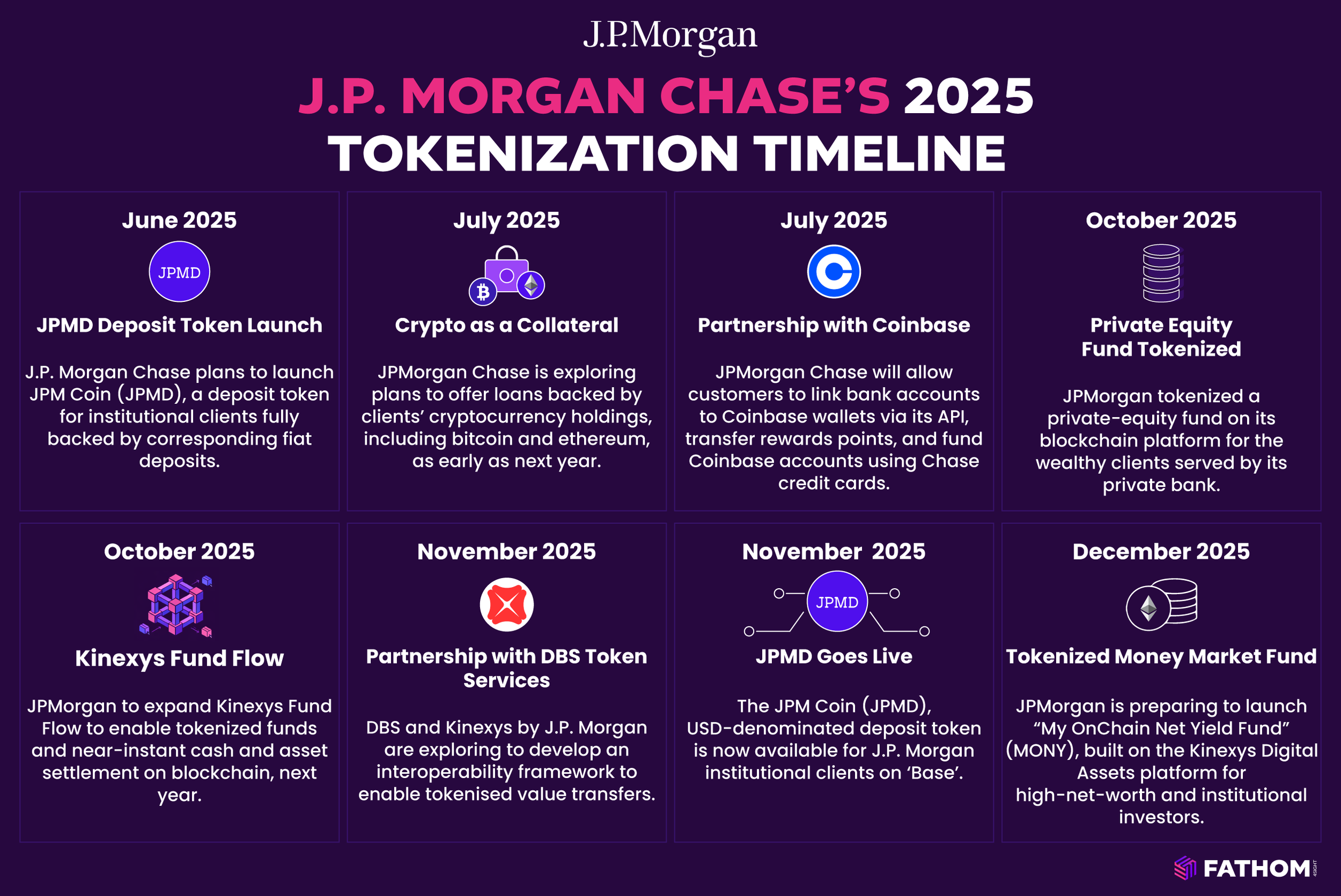
J.P. Morgan Chase’s Tokenization and Digital Asset Activity Throughout the Year
Introduction of JPMD: The bank outlined plans for a deposit token representing commercial bank money, issued exclusively to institutional clients. Each token is fully backed by corresponding fiat deposits and transmitted via smart contracts on the Base blockchain.
Crypto-backed lending: The bank is exploring the possibility of offering loans secured against client-held digital assets, including bitcoin and ethereum, extending digital assets into collateralized lending use cases.
Partnership with Coinbase: JPMorgan partnered with Coinbase to enable Chase customers to link their bank accounts directly to Coinbase wallets via JPMorgan API. It enables bank-to-wallet transfers, one-to-one conversion of reward points and fund Coinbase accounts using Chase credit cards.
Tokenized private equity fund: JPMorgan tokenized a private equity fund on its blockchain platform, providing private banking clients with real-time visibility into fund ownership and capital commitments to improve capital call management.
Expansion of the Kinexys Fund Flow platform: The bank is preparing a wider rollout of Kinexys Fund Flow, which aggregates data from fund managers, administrators, and distributors to generate smart contracts representing fund ownership and support near-instant settlement of cash and assets.
Interbank tokenised deposit framework with DBS: JPMorgan, through Kinexys Digital Payments, collaborated with DBS to develop an interoperability framework enabling cross-bank, cross-border transfers of tokenised deposits across public and permissioned blockchains.
JPM Coin (JPMD) live on Base: JPMorgan made its USD-denominated deposit token, JPM Coin (JPMD), available to institutional clients on the Base blockchain, supporting on-chain digital payments that represent bank deposits on a public network.