

Embedded Lending: Real-Time Decisioning to Agentic Credit
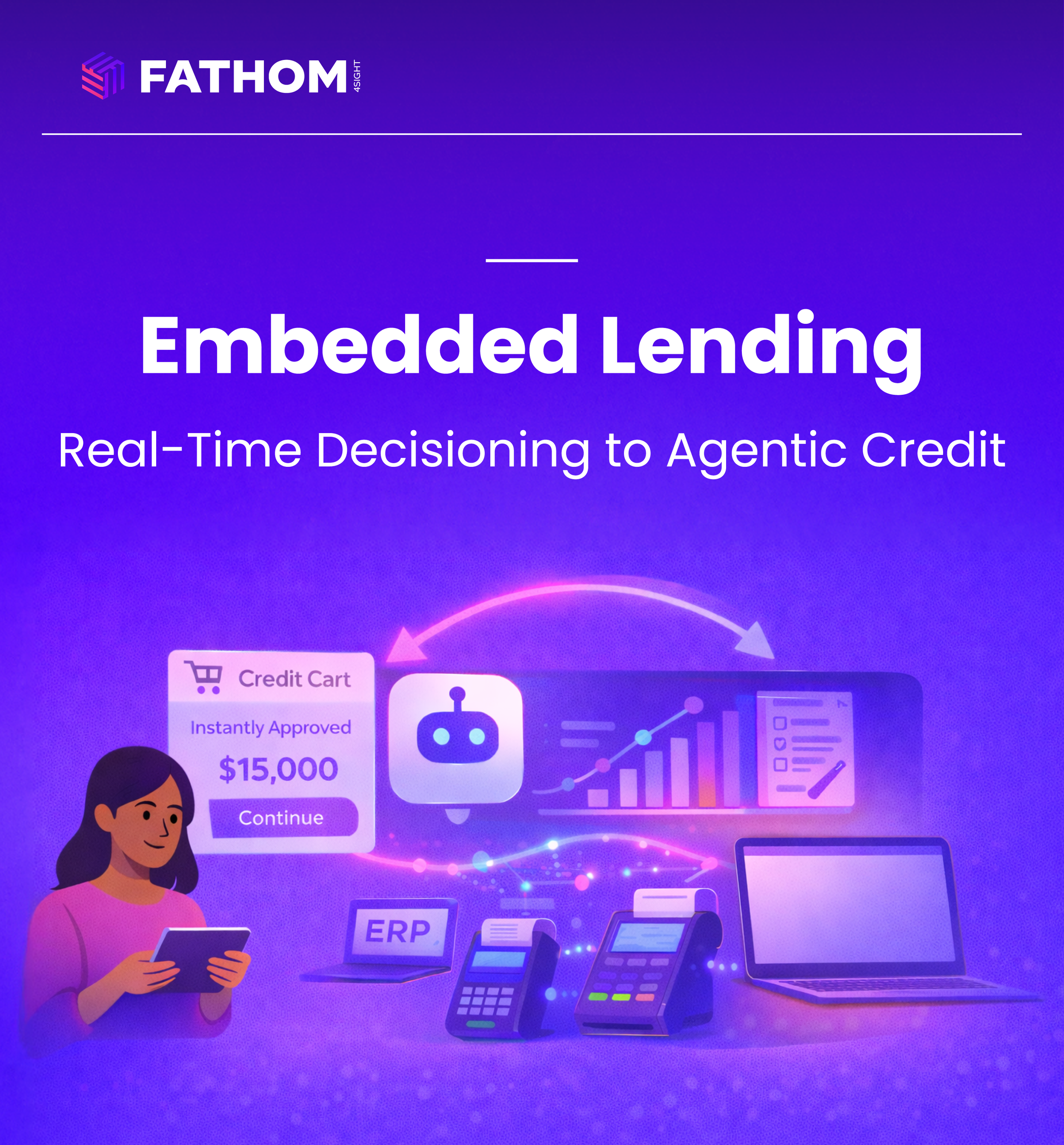
Historically, lending has been built around applications, documents, and waiting.
With technology, this began to change. Automated lending introduced real-time evaluation engines - pulling data from multiple sources, applying rules and models instantly, and accelerating credit decisions.
The next shift was structural, moving lending inside platforms, such as accounting software, ERPs, POS systems, and marketplace seller portals - giving rise to embedded lending, where real-time underwriting is powered by granular operational and cash-flow data.
Now, a new transformation is emerging. With agentic AI, even embedded lending can evolve further to Agentic Credit, where natural language prompts can trigger real-time underwriting, dynamic credit-limit adjustments, and access to additional funds.
So how did we get here, and what does this actually unlock?
What Embedded Lending Really Means
Embedded lending is when credit is offered inside a non-bank platform, not through a separate loan application.
For Businesses:
Credit appears inside platforms businesses already use - commerce, accounting, POS, or ERP
Underwriting uses live operational and cash-flow data available to the platform, along with additional data accessed via APIs
Typical use cases include paying suppliers early to capture discounts, financing inventory and/or raw material procurements, smoothing cash-flow gaps, and funding growth opportunities
For Consumers:
Credit is embedded at merchant checkout or inside marketplace & everyday apps
Decisioning happens in real-time based on contextual signals (basket size, customer identity verification status, customer location, past transaction patterns, repayment history, etc.)
👉 Lending moves to where the need arises.
The Shift: From Static Underwriting to Continuous Signals
Traditional lending involves:
Periodic applications
Historical financial statements
One-time risk assessment
Embedded lending moves to:
Ongoing access to sales, invoices, cash flows, payments
Dynamic eligibility, pre-approvals, or offers refreshed as data updates
Credit that adapts as the business evolves
👉 Risk assessment becomes continuous, not episodic.
Major Embedded Lending Models
Platform-Based Working Capital:
Credit tied to platform sales & payouts, such as acquirer or POS platforms
Repayment auto-deducted from revenue
Invoice & Receivables Financing:
Funding triggered by invoices inside accounting systems
Underwritten using real-time A/R data
Consumer Analogue: Installment Facilities & BNPL
Credit embedded at point of purchase
Decisioning happens at the moment of transaction using available contextual data
👉 Same idea - different insertion points.
Why This Works for Platforms & FinTechs
Rich proprietary data improves underwriting quality
Personalized and contextual credit offering deepen platform stickiness
Automated repayments from sales cashflows reduce default risk
Monetization without owning the balance sheet - in cases where platforms provide underwriting data and loan distribution, while an external partner funds the loans
👉 Lending becomes a platform feature, not a standalone product.
Financial Institution Perspective
Banks access new distribution via platforms
Lower acquisition and servicing costs
Better risk visibility using live data feeds
Credit embedded without owning the end UI
👉 Banks power credit behind the scenes.
The Future: Agentic Credit
Merchant’s employee or manager expresses intent in natural language via the platform’s AI agent chatbot:
“Can we afford to place a 20% larger inventory order this week to prepare for the upcoming holiday season?”
AI agent assesses current cash balance, cash-flow expectations, and available credit limits using embedded data and lending APIs:
“For a 20% larger inventory order, our cash balance falls short by $10,000 and existing credit limits are exhausted. However, cash-flow expectations support a credit-limit increase. Should I request to increase credit limit by $10,000?”
Credit actions are executed within predefined guardrails - recommending, triggering, or sequencing financing automatically:
“Happy to report that the account has been funded with an additional $10,000. Would you like me to place the inventory order now?”
👉 Credit shifts from applications to intent-driven execution.