

Google Launches Universal Commerce Protocol (UCP)
Google Launches Universal Commerce Protocol for Agentic Payments
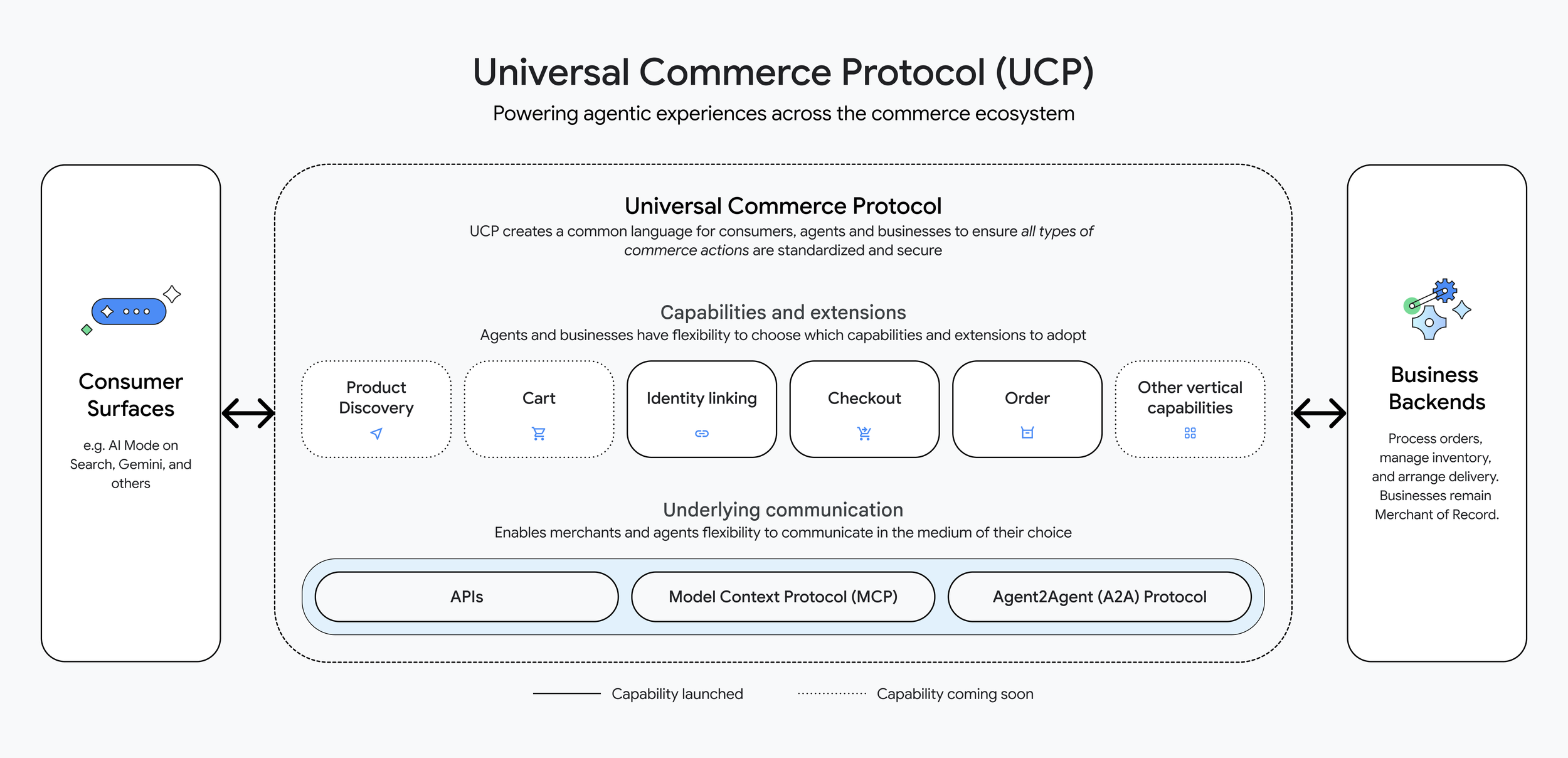
Google has introduced the Universal Commerce Protocol (UCP) - an open-source standard intended to support the next phase of agentic commerce by creating a common language between consumer surfaces, business systems, and payment providers.
UCP defines standardized functional building blocks (primitives), so commerce journeys - such as discovery, cart creation, and checkout - can work more seamlessly across different platforms, while remaining compatible with existing retail infrastructure.
It is also compatible with the Agent Payments Protocol (AP2) to support secure agentic payments, and offers businesses multiple integration paths through APIs, Agent2Agent (A2A), and the Model Context Protocol (MCP).
UCP is Built to Benefit the Entire Commerce Ecosystem
For Businesses (merchant control + flexibility): UCP enables businesses to surface products/services across shopping touchpoints like AI Mode in Search and the Gemini app. Businesses keep control of their business logic and remain the Merchant of Record, including an embedded option to preserve a customized checkout.
For AI Platforms (standard onboarding + choice of frameworks): UCP helps AI platforms enable agentic shopping through standardized APIs. Platforms can simplify onboarding while allowing businesses to use MCP, A2A, and existing agent frameworks.
For Developers (community-driven standard): UCP is positioned as an evolving open-source standard intended to be shaped by the community. It invites developers to build and extend the next generation of digital commerce experiences.
For Payment Providers (modular interoperability + provable consent): UCP introduces an open, modular payment handler design to support interoperability and multiple payment methods. Every authorization is designed to be backed by cryptographic proof of user consent.
For Consumers (lower friction + benefits-aware purchasing): When brands adopt UCP, it reduces friction from product discovery to decision and checkout. The intent is to improve confidence in purchases and include member benefits as part of the value delivered.
Source: Google Blog
How It Works
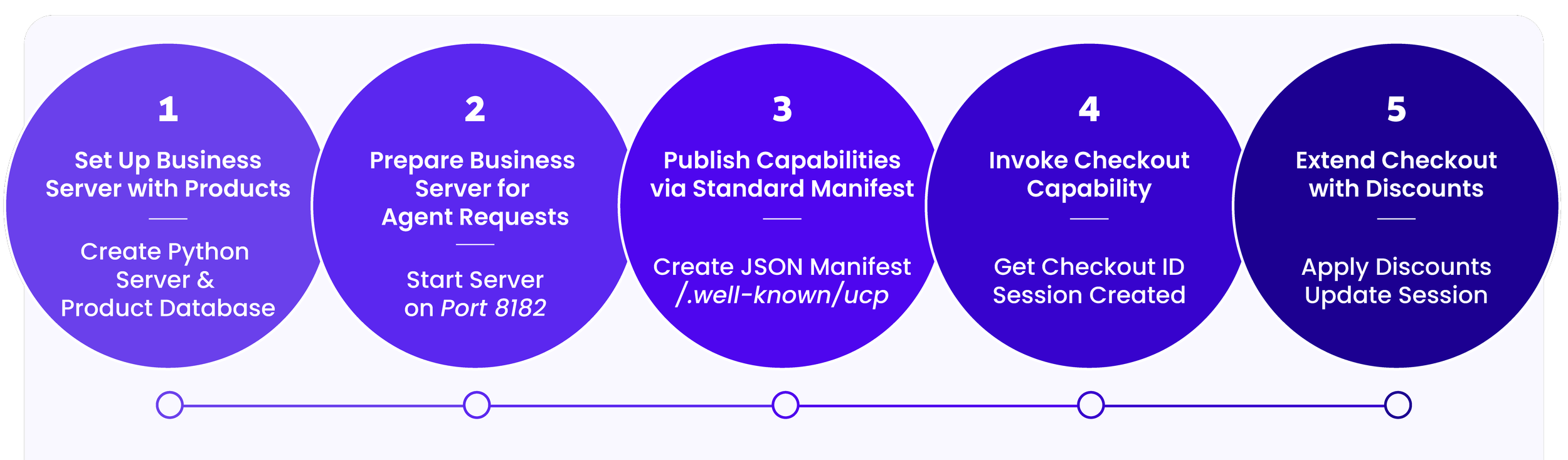
Set up a Business Server with Products: A sample business store can be created using the provided Samples repository, including a Python server for Business APIs and a UCP SDK with sample product data. This forms the backend that agents can interact with.
Prepare the Business Server for Agent Requests: The business server is started (example: hosted on port 8182) and connected to the sample product database. This keeps business APIs accessible so agents can connect and transact.
Publish Capabilities via a Standard Manifest: Businesses publish supported services and capabilities using a standard JSON manifest at: /.well-known/ucp. Agents use this to discover features, endpoints, and payment configurations dynamically without hard-coded integrations.
Invoke Checkout Capability (create session + receive checkout ID): An agent initiates checkout through the checkout capability. After the session is created, the agent receives a checkout ID which enables follow-up updates to the checkout session.
Extend Checkout with Discounts (capability extensions): UCP supports capability extensions such as discounts. An agent can apply discounts during checkout and receive an updated response reflecting the discount application.
Integrate with Google - a Checkout Feature
While UCP is intended to be vendor-agnostic and usable across any surface, Google has built the first reference implementation to support a new buying experience across its conversational environments such as AI Mode in Search and the Gemini app. This implementation enables purchases from eligible businesses directly within these experiences, and supports payment flows using Google Pay, leveraging payment and shipping information stored in Google Wallet to reduce checkout friction.
__
UCP is positioned as a collaborative, open-source effort co-developed and endorsed by more than 20 partners across the ecosystem. Google is inviting developers, businesses, and platform architects to participate - by exploring the specification on GitHub, sharing feedback through GitHub Discussions, and contributing through pull requests.